
“Landscape-led masterplanning represents one of the most consequential shifts in urban design thinking of the past century.”
Landscape-led masterplanning represents one of the most important shifts in how cities are conceived and built. For most of the 20th century, landscape was the last decision made in a masterplan. Buildings went in first. Roads followed. Whatever land remained was handed to the landscape architect to fill with greenery. That model is broken — and the cities it produced prove it.
Walk through most urban developments built in the last fifty years and you feel the consequences immediately: spaces between buildings with no reason to pause, parks that feel unsafe because they were positioned where no building wanted to go, planting that looks like an afterthought because it was. The landscape was fitted around the architecture, not integrated with it.
Landscape-led masterplanning reverses that order. It places the land itself — its topography, ecology, water systems, and natural character — at the foundation of the masterplan, before a single building footprint is drawn. The result is not simply a more attractive development. It is a fundamentally more livable, more resilient, and more ecologically coherent one.
The Problem With Putting Buildings First
The conventional masterplanning process works from a familiar logic: site boundaries are established, zoning is applied, building envelopes are positioned, and the landscape is designed around whatever space remains. This approach has a name in design theory — shape-making rather than place-making.
When buildings go in first, the structural outcome is predictable: sunless canyons between building facades, windy spaces with dead edges, ill-defined leftover land absorbed by car parking, weak pedestrian connectivity, and green space that exists wherever buildings chose not to go rather than wherever people need it most. These are not individual design failures. They are the inevitable result of a process that treats landscape as a residual condition rather than an organizing framework.
“Space has traditionally been conceptualised in relation to buildings, but this leads to shape-making rather than place-making.”
Landscape Institute — Planning for a Healthy Environment
The deeper issue is structural. Landscape systems — ecological corridors, water cycles, biodiversity networks, topographic logic — do not bend to fit around buildings without losing their function. A green corridor squeezed between building backs is not a functioning ecological pathway. A park positioned where no building wanted to go is not a genuine community space. Landscape that follows architecture is rarely landscape that works.
What Landscape-Led Masterplanning Actually Means
Landscape-led masterplanning is not an aesthetic preference. It is not a commitment to more trees or wider pavements. It is, fundamentally, a change in the order of thinking — and in who sits at the head of the table during the earliest phases of a project.
At its core, the approach means bringing landscape architects into the masterplanning process before building envelopes are defined, before road networks are fixed, and before zoning assumptions have hardened into layout decisions. The site’s natural systems — its topography, drainage patterns, ecological value, prevailing winds, solar orientation, and inherited landscape character — become the primary organizing framework for everything that follows.
Buildings are then positioned in response to this framework. Movement routes follow natural desire lines and topographic logic. Green corridors are sized and connected to function as genuine ecological pathways, not decorative strips. Water is managed as a landscape asset from the beginning, not an engineering problem addressed at the end.
Core Definition
Landscape-led masterplanning is the discipline of using the land’s natural systems — topography, ecology, water, and climate — as the primary framework around which all other elements of an urban plan are organized.
The Intellectual Foundation: Landscape Urbanism
The theoretical grounding for landscape-led masterplanning was consolidated by Charles Waldheim, Professor of Landscape Architecture at Harvard University’s Graduate School of Design, in his foundational work on Landscape Urbanism. Waldheim argues that landscape, more than buildings or infrastructure, has fundamentally changed the way cities urbanize in the 21st century.
His central proposition is direct: landscape urbanism is the theory of urban planning through the medium of landscape — not alongside it or decorating it, but through it. The landscape architect, in this framework, becomes the urbanist. The land becomes the primary design medium.
“It has become conventional to think of urbanism and landscape as opposing one another — or to think of landscape as merely providing temporary relief from urban life as shaped by buildings and infrastructure. But landscape has recently emerged as a model and medium for the city.”
Charles Waldheim — Landscape as Urbanism: A General Theory, Princeton University Press, 2016
Waldheim traces this lineage back to Frederick Law Olmsted, the 19th-century American landscape architect whose work demonstrated that landscape could be the organizing structure of an entire city — not a park inserted into an already-planned urban grid, but the framework around which urban life organizes itself. Olmsted’s Central Park in New York was not landscaping added to a city. It was the city organizing itself around a landscape decision that has defined the quality of life in Manhattan for 160 years.
The question of whether all masterplans should be landscape-led has moved from theoretical debate into mainstream professional practice. The answer emerging from research, policy, and built evidence globally is unambiguous: yes. And the arguments are no longer theoretical. They are backed by measurable evidence.
What the Research Says About Landscape-Led Masterplanning
“The case for landscape-led masterplanning is no longer theoretical.”
01 · Green Infrastructure and Climate Resilience
Urban green infrastructure — parks, green corridors, urban forests, wetlands, green walls, and street trees — is now one of the most rigorously documented tools in urban climate adaptation. A 2024 systematic review published in Springer’s journal Sustainability Science confirmed measurable benefits across heat mitigation, air quality improvement, stormwater management, and biodiversity support. The review found that urban green infrastructure functions most effectively when it is planned as an integrated network — not as isolated green elements scattered between buildings.
A 2025 interdisciplinary review from University College London’s Bartlett School of Planning, analyzing 178 primary research articles published between 2015 and 2025, found that urban green spaces are associated with reduced chronic disease incidence, lower mortality rates, improved mental health outcomes, and reduced urban heat island effects. The study identifies seven key implications for urban policy and spatial planning — all pointing toward the integration of green infrastructure into the structural framework of urban design from the earliest planning stages.
02 · The Shift from Building Models to Environmental Systems
The focus in progressive masterplanning is shifting decisively away from 3D modelling of buildings into dynamic modelling of environmental systems and how people use space. The questions that matter most in a contemporary masterplan — how heat moves through a community, where stormwater collects and flows, how ecological corridors function across the site — are landscape questions. They cannot be answered after the buildings are placed. They require landscape thinking at the foundation of the process.
03 · Property Value and Community Identity
Research consistently demonstrates that well-designed green infrastructure adds measurable property value and strengthens community identity. A Nature npj Urban Sustainability study published in 2024 found that integrating green infrastructure into dense urban development reduces resource use and enhances ecosystem services across multiple dimensions — confirming that the investment made in landscape-led planning generates compounding returns over the life of a development.
Beyond economics, landscape creates shared understanding of a place. It connects to memory, identity, and the lived experience of a site in ways that architecture cannot replicate. Buildings are abstract during a planning process. The land — a river, a ridge, a tree line, a view — is not. This is why landscape issues are consistently the most effective basis for early consultation with communities and statutory authorities.
Six Outcomes That Change When Landscape Leads
- Ecological corridors are sized and positioned to function — not squeezed into leftover space between buildings
- Water is managed as a landscape asset from the beginning, reducing long-term infrastructure cost
- Pedestrian and cycling networks follow natural desire lines and topographic logic rather than fitting around building envelopes
- Microclimate management — shade, wind protection, cooling — is embedded in the plan rather than retrofitted
- Biodiversity is structurally supported through connected green networks, not incidentally present through isolated planting
- Community identity is rooted in the land — durable, specific, and resistant to the aging of architectural styles
How the Discipline Applies Landscape-Led Masterplanning
The Landscape Institute in the United Kingdom formally recognizes landscape-led masterplanning through its Excellence in Masterplanning and Urban Design Award, which specifically celebrates projects where landscape professionals have led or fundamentally shaped the urban design outcome. The award criteria require judges to assess the degree to which the entry demonstrates that landscape has driven the masterplan — not decorated it.
ASLA’s current Climate and Biodiversity Action Plan places biodiversity alongside climate as a core priority for landscape architecture practice, encouraging designers to apply landscape ecology principles and consider biodiversity across multiple planning scales — from the individual site to the regional corridor. This reinforces the need for landscape thinking to begin at the masterplanning stage, where decisions made about land use, green network connectivity, and ecological buffers determine whether biodiversity goals are achievable at all.
At the urban scale, the most successful contemporary developments are those where the landscape framework is the generative idea — the organizing logic from which all other elements grow. The green network is not the setting for the buildings. The buildings are positioned within the landscape system.
“Bringing landscape architects to sit at the table at the very start is a recognition that the spaces outside are equally as important as the spaces inside buildings.”
Landscape Institute — Planning Guidance, 2024
The Climate Imperative in Arid Regions
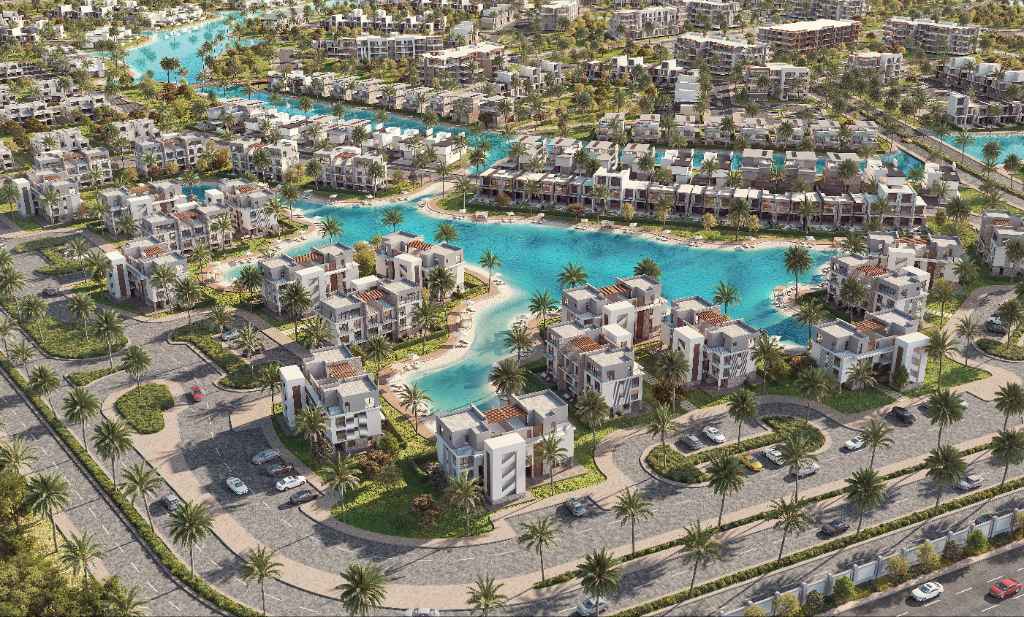
“In arid regions, landscape-led masterplanning carries additional urgency.”
In arid and semi-arid climates — across the Middle East, North Africa, and the Gulf — the argument for landscape-led masterplanning carries additional urgency. The challenges of extreme heat, water scarcity, and ecological fragility cannot be resolved by architecture alone. They are fundamentally landscape problems that require landscape solutions embedded into the masterplan from the beginning.
When landscape leads in these contexts, it means native and drought-tolerant planting selected and positioned from the outset, water-efficient irrigation systems designed as integrated infrastructure rather than afterthoughts, and green corridors oriented to manage heat, shade pedestrian routes, and provide ecological connectivity across the site. These elements require masterplan-level decisions — they cannot be added later without compromising the integrity of what has already been built around them.
The alternative — buildings planned first, landscape fitted around them, sustainability measures applied as a retrofit — produces communities that work against their climates rather than with them. In an era of accelerating climate change and increasingly stringent sustainability requirements across the MENA region, this approach is no longer viable.
UNEP identifies urban nature and nature-based solutions as essential components of climate adaptation for cities in hot and arid environments, including responses to extreme temperatures, water stress, soil erosion, and biodiversity loss. The consistent finding across this body of research is that these strategies deliver their maximum benefit when integrated at the masterplanning scale — not applied to individual buildings after the urban structure is fixed.
The Core Shift
The question is no longer whether masterplanning should be landscape-led. The evidence — theoretical, empirical, and practical — answers that clearly. The question is how quickly the industry completes the transition from a building-first model to a land-first one.
Conclusion
Landscape-led masterplanning is not a trend born of environmental fashion. It is a correction of a structural error that the conventional masterplanning process has carried for decades — the error of treating the land as background rather than foundation.
The intellectual case was made by Olmsted in the 19th century and theorized by Waldheim in the 21st. The empirical case is now documented in peer-reviewed research across climate science, public health, ecology, and urban economics. The institutional case is endorsed by the Landscape Institute, ASLA, UNEP, and the World Bank. The practical case is demonstrated in the built outcomes of developments where landscape led and those where it did not.
What changes when landscape leads is not simply the appearance of a development. What changes is whether the development functions — ecologically, climatically, socially, and over time. Architecture is built and eventually replaced. Landscape, properly conceived and properly integrated, endures.
A place is not a static thing. It is built from memory, from seasonal change, from the quality of light through a tree canopy, from the sound of water, from the coherence of a green network that connects one part of a community to another. Landscape understands this. The masterplan should begin there.
Sources & Further Reading
- Waldheim, C. (2016). Landscape as Urbanism: A General Theory. Princeton University Press.
- Landscape Institute. (2024). Planning for a Healthy Environment — Good Practice Guidance for Green Infrastructure.
- Landscape Institute. Excellence in Masterplanning and Urban Design Award Criteria. 2025.
- Jia, Y. & Turcu, C. (2025). Climate, Health, and Urban Green Infrastructure: Evidence and Implications for Urban Policy and Spatial Planning. UCL Bartlett School of Planning. International Journal of Environmental Research and Public Health.
- Springer Nature. (2024). Benefits and Co-Benefits of Urban Green Infrastructure for Sustainable Cities. Sustainability Science.
- Nature npj Urban Sustainability. (2024). Optimizing Green and Gray Infrastructure Planning for Sustainable Urban Development.
- ASLA. (2024). Climate & Biodiversity Action Plan. American Society of Landscape Architects.
- UNEP. (2023). Nature-Based Solutions for Urban Climate Adaptation. United Nations Environment Programme.
- World Bank. (2023). Nature-Based Solutions for Urban Resilience.