
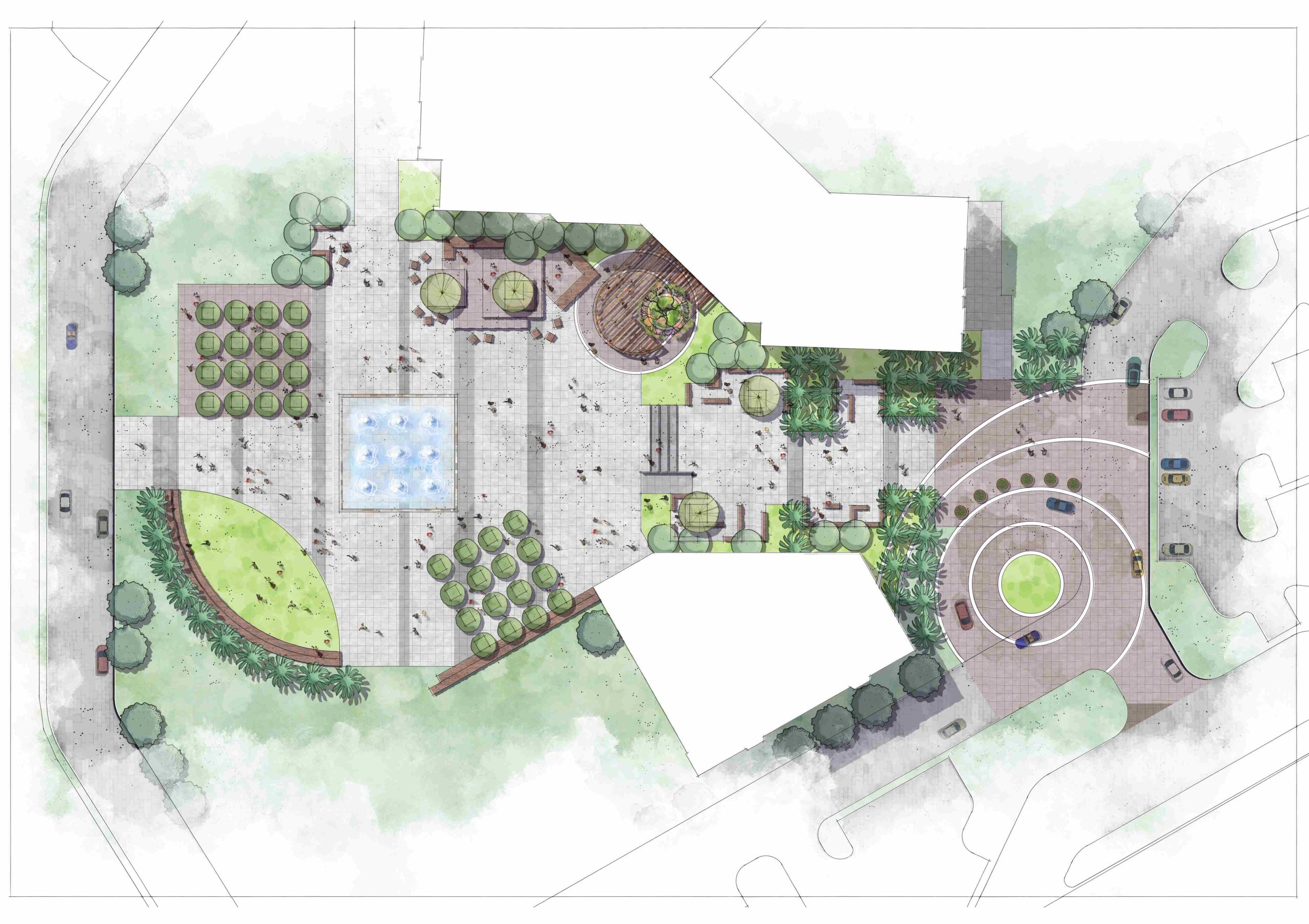
Case Study: UNIVERSITY OF CANADA
Client: Canwell Education Consultancy
Location: New Administrative Capital, Egypt
Area: 180 000 m²
Scope: Landscape Architecture, 10-Year Sustainability Strategy
Project Overview
Schaduf was appointed as the landscape and sustainability consultant for the inaugural University of Canada campus in Egypt’s New Administrative Capital. Spanning 180 000 m², this landmark development is the region’s first Canadian higher-education center, serving students from Egypt and across the Middle East. Our remit encompassed a comprehensive 10-year sustainability strategy, the landscape architecture of all outdoor spaces, and the design of a 27 m-high indoor vertical garden—establishing a living prototype for future campus developments.
Challenges
- First-of-its-Kind Identity: Creating a landscape that reflects Canadian academic values while responding to Egypt’s desert climate and cultural context.
- Long-Term Resilience: Developing a strategic roadmap to secure water, energy, and maintenance efficiencies over a decade.
- Vertical Integration: Engineering a 27 m indoor green wall that performs horticulturally, enhances indoor air quality, and anchors the campus heart.
Solutions
- 10-Year Sustainability Roadmap: Phased implementation plan addressing water conservation (drip-irrigation, rainwater harvesting), energy-efficient lighting, and low-impact maintenance protocols.
- Contextual Planting Palette: Selection of native and climate-adaptive species for outdoor plazas, courtyards, and circulation corridors—minimizing irrigation needs and maximizing shade, biodiversity, and seasonal interest.
- Indoor Vertical Garden Design: Modular living-wall system featuring automated micro-irrigation, integrated air-filtration planting modules, and built-in biodiversity niches; positioned to serve as a learning laboratory and social atrium feature.
Outcomes
- Model Eco-Campus: The campus now stands as a best-practice exemplar for sustainable educational environments in Egypt’s New Capital, influencing policy and future projects.
- Resource Savings: Outdoor landscapes achieve up to 40 % water reduction through smart irrigation and drought-tolerant planting.
- Well-Being & Engagement: The vertical garden elevates indoor comfort, fosters interdisciplinary research, and enhances student and faculty well-being.
Conclusion
Through a decade-long sustainability strategy, site-specific landscape design, and an iconic indoor vertical garden, Schaduf has shaped a campus that educates and inspires. The University of Canada in Egypt embodies a new paradigm of resilient, human-centered academic environments—where landscape architecture and sustainability converge to set the standard for the region’s future educational landmarks.