
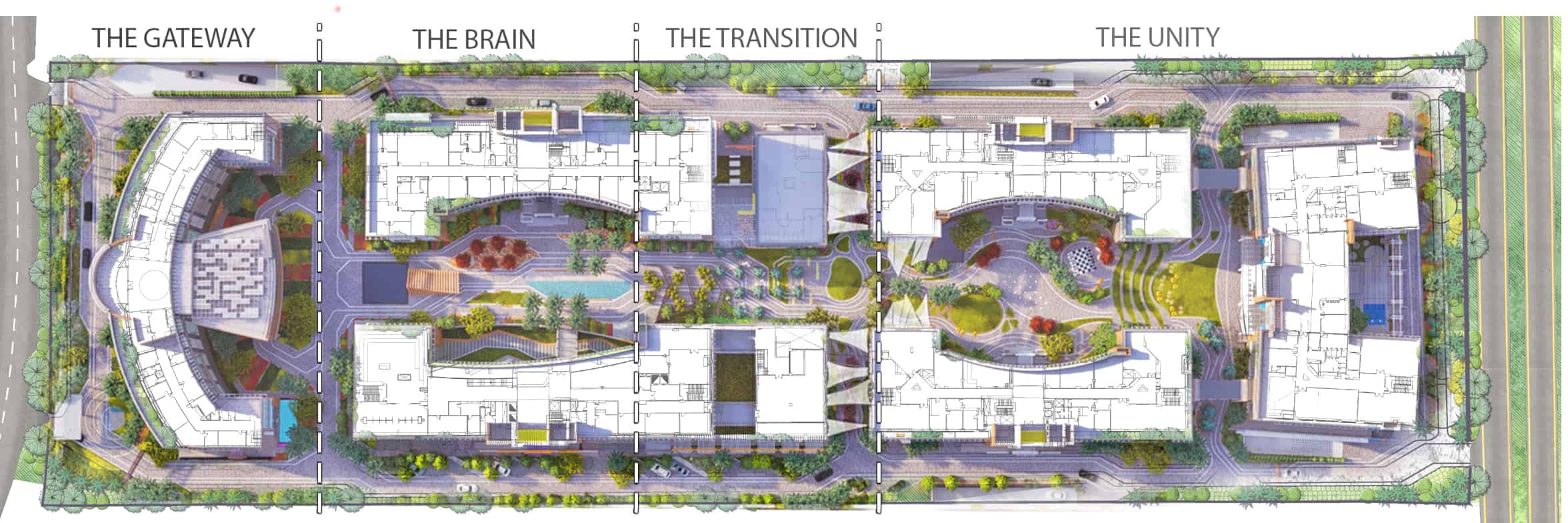
Case Study: National Training Academy Campus
Client: IMKAN Misr
Location: Sheikh Zayed, Egypt
Area: 60,000 m²
Scope: Planning, Urban Design, Landscape Architecture
Project Overview
The National Training Academy Campus serves as Egypt’s first dedicated intellectual incubator and catalyst for human development. Tasked with fostering creativity and innovation in tomorrow’s leaders, the Academy required an outdoor environment that seamlessly blends learning, play, and collaboration. Schaduf collaborated closely with the Academy to craft a “gamified” landscape where lectures, workshops, and activities flow together in an engaging journey through purpose-built outdoor rooms.
Challenges
- Innovative Pedagogy in Landscape: Designing a campus that supports non-traditional, activity-led learning methods—where outdoor spaces become classrooms and laboratories.
- Spatial Sequencing: Organizing 60,000 m² into distinct zones for instruction, social interaction, and reflection, while maintaining a coherent campus identity.
- Climate Adaptation: Providing comfortable, year-round usability in Sheikh Zayed’s hot, arid climate without overreliance on mechanical cooling.
- Stakeholder Alignment: Ensuring the design met the Academy’s educational objectives, security requirements, and long-term flexibility needs.
Solutions
- Collaborative Visioning Workshops: We engaged faculty, students, and leadership in visioning sessions to map desired “learning moments” onto the site, translating pedagogical goals into spatial form.
- Zoned Activity “Rooms”: The landscape was divided into interactive nodes—amphitheaters for lectures, challenge courses for team building, reflective gardens for individual study, and open lawns for informal gatherings—each linked by a meandering “learning trail.”
- Passive Comfort Strategies: Shaded pergolas, wind-catching green corridors, and water-mist features were integrated to cool key activity areas naturally, extending outdoor usability.
- Flexible Infrastructure: Modular seating, movable planters, and universal-design walkways ensure the campus can adapt to evolving program needs over time.
Outcomes
- Engaging Outdoor Classroom: The gamified sequence of spaces has transformed traditional pedagogy, leading to measurable increases in student collaboration and retention.
- Cohesive Campus Identity: Distinct activity zones are unified by consistent materials and planting palettes, reinforcing a strong sense of place and institutional pride.
- Enhanced Comfort & Sustainability: Passive shading and native, drought-tolerant planting reduce water use and energy consumption while maintaining year-round comfort.
- Scalable Model for Learning Landscapes: The campus design has become a benchmark for experiential education environments in the region.
Conclusion
Through a deeply collaborative process and a commitment to innovation, Schaduf created a landscape that does more than beautify—it educates, inspires, and adapts. The National Training Academy Campus stands as a testament to the power of purposeful landscape architecture in shaping the leaders of tomorrow.